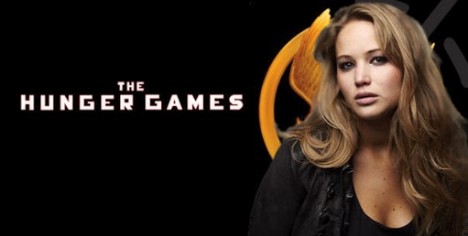
 She doesn't look sexually clueless, does she? Doesn't look all that hungry either. I began by badmouthing "The Hunger Games" at work, calling it shallow, unoriginal, and completely undeserving of the praise showered upon it by all the bored housewives and Harry Potter junkies that seem to love it, amongst so many others. My remarks were met with outrage and condescension; I seem to have destroyed my credibility with the entire accounting department comprised of lonely middle-aged blonde ladies who, I'm guessing, read only the most popular tripe to hit the fad shelves, a couple books a year. It's not that I didn't like "The Hunger Games," at first. I did begin, after the first 100 pages, by drawing comparisons with "Ender's Game," and, after a regrettable Facebook post in which I stated this fact, received an unusual number of comments saying things like: "Alright, you caught my attention with the Ender reference. I may have to sacrifice my long run of book avoidance..." I must apologize. I am so sorry. Please forget what I said. Don't bother with this book!
I only thought of "Ender's Game" because "The Hunger Games" involves a child protagonist in a dystopian society of the future thrust into a "game" of sorts that holds bitter consequences the protagonist fails to fully understand. And I only read "The Hunger Games" because of my experience with the Harry Potter series in which I originally turned my nose up at, feeling a series written for children and with such mainstream popularity was probably not for someone like me, but with Mr. Potter I was forced to eat my disparaging sentiments and came to fully enjoy all seven of the Harry Potter books. I thought, maybe, "The Hunger Games" would be like that. I was wrong. The only thing remotely interesting about "The Hunger Games" is the fucking Mocking Jay. Besides that, it is a blatant ripoff of Koushun Takami's "Battle Royale" ('99), mixed in, if we're being generous, with messy dollops of King's "The Long Walk" and "The Running Man." I mean, the story is exactly the same as "Battle Royale," minus any sort of character depth or psychological importance. The writing is poorly edited and uninspiring; it jumps and sputters along awkwardly. Katniss, our 16-year-old protagonist, is emotionally dull, somehow completely unaware that of all the boys around her who like her. She goes through the second half of the book kissing and sharing a sleeping bag with a boy named Peeta and manages to not have a single romantic or emotional feeling, thinking it's all just a game. The world, Panem, is somewhat bleak, but not fully realized--I have a hard time believing these games where children are randomly selected to kill each other have gone on for 74 years and only now are people thinking of revolution and parents becoming outraged. Is it possible no one has ever volunteered to take the place of their sibling before Katniss decided to? Not likely. I could go on, but I'll stop myself there. If you can take "The Hunger Games" at face value, without thinking about things too much, you may enjoy the series--many have, after all. My argument is only for the critical thinker, the seeker of literature like the tasting of fine wines, someone who, having tasted "The Hunger Games," might grimace, and exclaim, "Why, surely this is no wine. This is grape Coolaid!"
8 Comments
|
"Unrelenting Horror"- FREE!

An award-winning author known for blending elements of fantasy with horror in his surreal, literary style. Author of WITHIN, A GAME FOR GODS and VIOLENT HEARTS.
New Releases:
|
 RSS Feed